

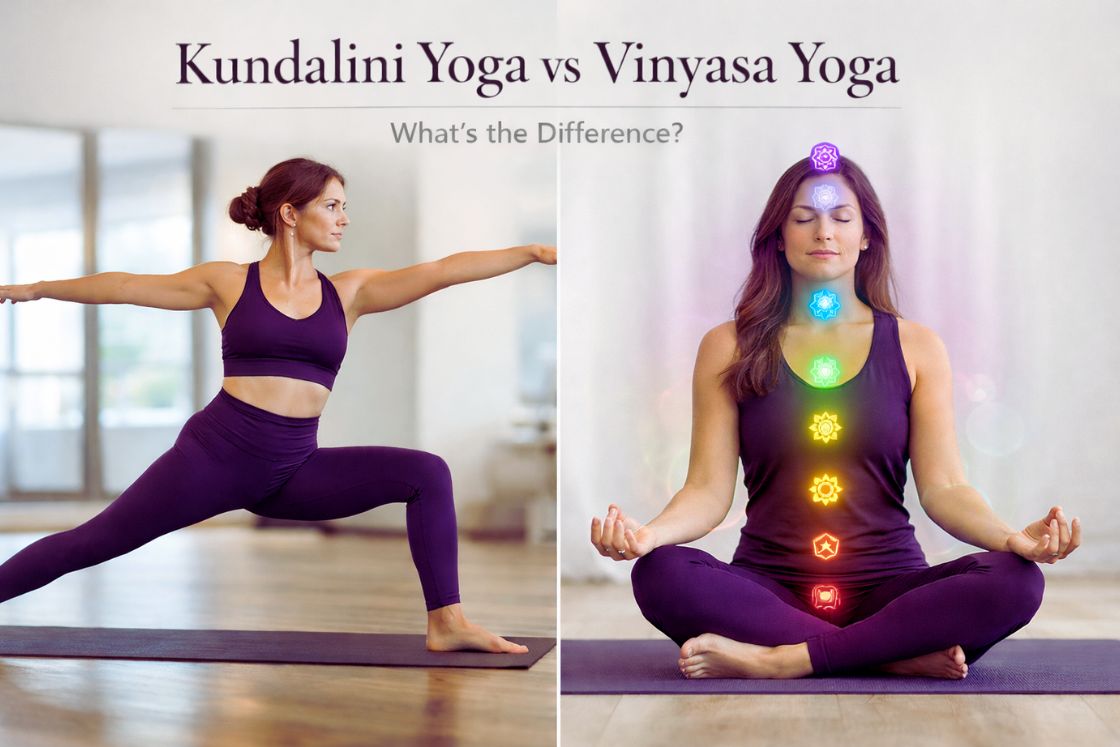
Kundalini yoga and Vinyasa yoga are two practices that usually seem in trendy yoga studios.
At first look they sound related. In spite of everything, each have the phrase yoga in them. However should you attend a category of every, the expertise can really feel fully completely different.
One class might have you ever shifting constantly via poses, constructing warmth and energy. One other might transfer extra slowly, specializing in breath, consciousness, and meditation.
Each are real yoga practices. They merely method yoga from completely different instructions.
This information will assist you perceive the distinction so you may determine which one matches the place you might be proper now.
No sophisticated philosophy. Only a clear rationalization of how these practices work.
The fast rationalization
The primary distinction between Kundalini yoga and Vinyasa yoga lies of their focus.
- Vinyasa yoga emphasises steady motion, linking poses along with the breath to construct energy, flexibility, and stamina.
- Kundalini-based yoga practices focus extra on breath management, meditation, and inside consciousness, aiming to stability the nervous system and develop deeper psychological readability.
Whereas Vinyasa tends to really feel like a bodily exercise, Kundalini-oriented practices usually emphasise respiratory strategies, meditation, and gradual internal growth.
Key variations between kundalini and vinyasa yoga
| Characteristic | Vinyasa Yoga | Kundalini-Primarily based Yoga Practices |
|---|---|---|
| Main focus | Motion and bodily circulate | Breath, consciousness, and inside stability |
| Depth | Bodily demanding | Internally targeted |
| Sweat stage | Medium to excessive | Normally low |
| Tempo | Steady motion | Slower and extra structured |
| Essential instruments | Yoga poses linked with breath | Pranayama, meditation, mudra, and asana |
| Ambiance | Lively and dynamic | Calm and inward |
| Outcomes usually felt | Power, flexibility, stamina | Psychological readability, calmness, emotional stability |
A bit of background: the place these kinds come from
Trendy yoga has developed in lots of instructions during the last century.
Vinyasa yoga grew out of recent postural yoga traditions influenced by Tirumalai Krishnamacharya and his college students. Dynamic movement-based kinds later unfold world wide via academics resembling Pattabhi Jois.
Kundalini practices have a special background.
The concept of kundalini power seems in older yogic and tantric texts, the place it describes a latent power throughout the human system that may awaken via devoted apply.
In traditions such because the Bihar College of Yoga, established by Swami Satyananda Saraswati, kundalini is approached step by step via a mixture of yogic practices moderately than a single class model.
It’s value noting that in lots of Western studios the time period Kundalini Yoga usually refers to a particular system launched within the late Sixties by Yogi Bhajan.
Conventional yoga faculties in India, nonetheless, often train kundalini-related practices in a slower and extra systematic means.
In conventional yoga faculties influenced by the Satyananda custom, kundalini practices are often launched step by step as a part of a broader yoga apply moderately than taught as a single class model.
What occurs in a vinyasa yoga class
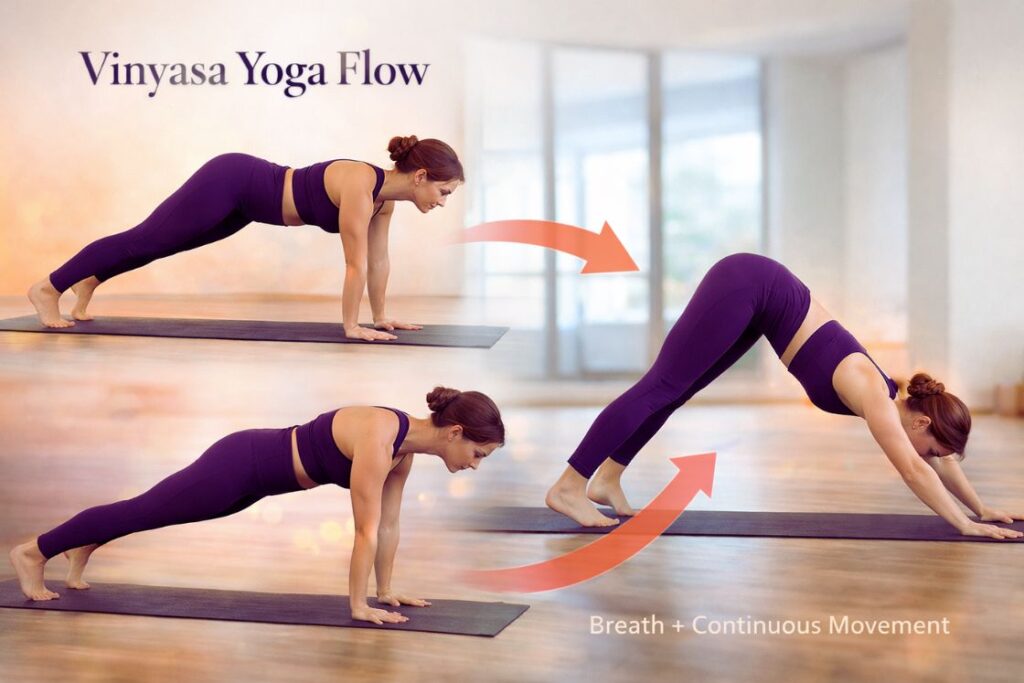
Most individuals discover Vinyasa simple to know as a result of it appears much like train.
You progress. You breathe. You sweat a little bit. And by the tip of the category, your physique feels labored.
You don’t must be versatile
Many rookies fear about flexibility earlier than their top quality. The reality is that flexibility develops via apply.
You don’t have to arrive versatile. The apply helps you construct it step by step.
A typical vinyasa class
Most courses run between 60 and 75 minutes.
Though every instructor creates their very own sequence, the overall construction is comparable.
The category often begins with mild motion to organize the physique. This may embrace easy stretches or actions resembling Cat–Cow to mobilise the backbone.
The center a part of the category is the place the tempo will increase.
You progress via sequences of poses resembling:
- Downward Canine
- Plank
- Chaturanga
- Warrior poses
The breath guides the motion.
An inhale usually opens the physique.
An exhale often folds or grounds the motion.
As a result of every instructor designs their very own sequence, no two Vinyasa courses are precisely the identical.
Towards the tip of sophistication the tempo slows. You progress into deeper stretches for the hips, backbone, and legs.
The ultimate minutes are spent resting on the again in Savasana. This enables the nervous system to settle and the physique to soak up the apply.
Many rookies say that is unexpectedly their favorite half.
What Vinyasa yoga develops over time
With common apply, Vinyasa yoga tends to enhance:
- muscular energy
- flexibility
- stability and coordination
- cardiovascular health
- psychological focus
For many individuals, the most important profit is the psychological reset that comes after bodily effort.
Transferring with breath calls for consideration. By the tip of sophistication the thoughts usually turns into quiet just because it has had one thing clear to give attention to.
What a conventional kundalini-based yoga apply appears like
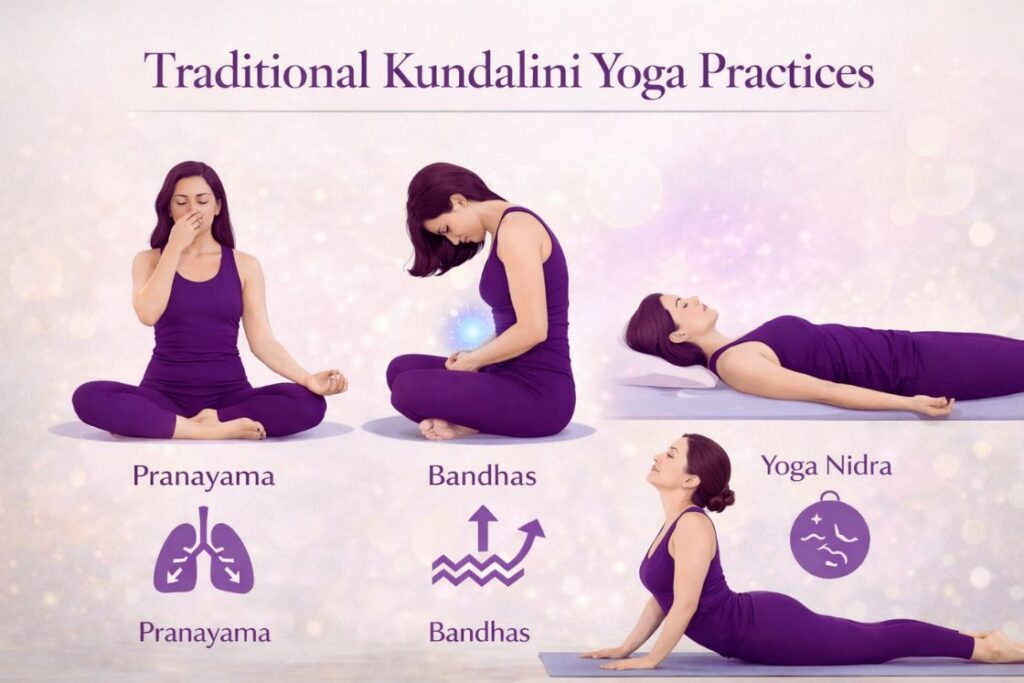
When individuals hear the time period Kundalini yoga, they usually think about a particular kind of sophistication.
In conventional yoga teachings, nonetheless, kundalini will not be a single model of yoga. It refers to a deeper course of throughout the yogic path.
In yogic traditions, kundalini describes a dormant potential energy believed to exist throughout the human system.
Due to this, conventional approaches don’t rush the method.
As an alternative, they use a mixture of practices that work collectively over time.
In traditions resembling these influenced by the Bihar College of Yoga, the practices that help this course of embrace:
- asana (bodily postures)
- pranayama (respiratory practices)
- mudra and bandha (energy-directing strategies)
- meditation
- deep rest practices resembling yoga nidra
Relatively than a hard and fast class sequence, these practices are launched step by step so the physique and nervous system can adapt safely.
Be part of Our 40-Day Dwell Tantra Kundalini Yoga Course
A typical construction of this type of apply
Though each instructor approaches it barely in another way, a conventional session usually consists of a number of phases.
1. Preparation via asana
The apply often begins with a couple of yoga postures.
These usually are not carried out primarily as bodily train, however as a strategy to take away stiffness from the physique and put together the backbone.
Light ahead bends, twists, and spinal actions are generally used.
The aim is to create a physique that may sit comfortably and breathe freely.
Finest Yoga Poses for Chakra Balancing
2. Pranayama
Respiration practices are one of many central instruments of yoga.
Methods resembling:
are used to affect the nervous system and stability the circulate of prana, the life pressure described in yogic traditions.
These practices can create a noticeable shift in psychological readability and tranquility.
3. Mudra and bandha
Because the practitioner turns into extra skilled, further strategies could also be launched.
Mudras and bandhas are delicate practices that direct inside power throughout the physique.
Examples embrace:
- Maha Mudra
- Moola Bandha
- Jalandhara Bandha
These practices are often realized step by step below steerage.
4. Meditation
Meditation helps stabilise consideration and develop internal consciousness.
Generally the meditation focuses on the breath.
Generally it includes mantra or easy commentary of the thoughts.
Over time, meditation develops steadiness that carries into on a regular basis life.
5. Deep rest
Practices resembling yoga nidra are sometimes included to combine the results of the apply.
Deep rest permits the nervous system to settle and may launch accrued bodily and psychological rigidity.
Many college students discover this half surprisingly highly effective.
What’s Yoga Nidra and it’s 4 Phases
What these practices do over time
When practiced constantly, these strategies can help:
- higher nervous system stability
- improved sleep high quality
- larger emotional stability
- elevated self-awareness
- a deeper sense of calm and readability
The modifications usually seem step by step moderately than dramatically.
For many individuals, the most important distinction is just feeling extra centred in each day life.
How usually do you have to apply?
Vinyasa: 2–3 occasions per week is a stable start line. This provides your physique time to recuperate and adapt between periods, whereas constructing momentum.
Kundalini: Even brief, each day apply creates a noticeable shift. A 20-minute morning session carried out constantly is extra highly effective than a 90-minute class as soon as per week. If you happen to can solely do 5 minutes on some days, do 5 minutes. Consistency issues greater than period..
Are you able to apply each?
Sure and it’s truly a strong mixture.
Vinyasa builds the bodily basis: the energy, flexibility, and breath consciousness that makes every thing else simpler.
Kundalini builds the interior basis: nervous system resilience, the power to sit down in stillness, and an internal steadiness that bodily health alone doesn’t at all times present.
Many individuals use each in the identical week. Vinyasa on the times it’s essential to transfer and really feel robust. Kundalini on the times it’s essential to go inward, reset, or work via one thing you may’t fairly title.
They’re not competing with one another. They’re engaged on completely different layers of the identical particular person.
Which yoga do you have to select?
Selecting between Kundalini-based practices and Vinyasa yoga relies upon totally on what you need out of your apply.
You may choose Vinyasa yoga should you:
- take pleasure in motion and bodily problem
- wish to enhance energy and suppleness
- choose a category that feels energetic and dynamic
- like selection in every session
You may choose kundalini-oriented practices should you:
- wish to develop meditation and breath consciousness
- really feel mentally confused or overstimulated
- have an interest within the deeper psychological features of yoga
- choose a slower and extra reflective apply
Many practitioners finally discover each approaches, utilizing movement-based yoga for bodily well being and breath or meditation practices for psychological stability.
Last ideas
There isn’t a single type of yoga that fits everybody.
Some individuals join instantly with the rhythm and bodily problem of Vinyasa.
Others uncover that slower practices involving breath and meditation deliver a deeper sense of stability.
An important factor will not be selecting the “greatest” model of yoga.
It’s discovering a apply that you’ll return to often.
Over time, that consistency is what permits yoga to unfold its actual advantages.
FAQs
Vinyasa is often extra bodily demanding due to steady motion.
Kundalini-based practices can really feel mentally difficult as a result of they contain breath management and meditation.
Each can work for rookies.
Individuals who take pleasure in bodily exercise usually begin with Vinyasa, whereas these thinking about meditation might choose breath-focused practices.
Vinyasa yoga typically burns extra energy as a result of it includes steady bodily motion.
Conventional kundalini practices are related to meditation and self-awareness, which many individuals take into account a part of a non secular path. Nevertheless, they may also be practiced merely for psychological stability and wellbeing.
Sure. Many individuals mix each kinds. Vinyasa builds bodily energy and suppleness, whereas breath and meditation practices assist develop psychological focus and rest.
Some practitioners are drawn to kundalini-oriented practices as a result of they focus extra on breath, meditation, and inside consciousness moderately than bodily motion alone.

