

Have you ever ever observed how your breath settles after a bodily exercise or at bedtime after a protracted, busy day? These quiet moments are sometimes once we really join with our interior selves.
Once you pay shut consideration to your breath, chances are you’ll really feel delicate sensations shifting by means of your physique. On the centre of this expertise, there’s a mild vibration- the sound of OM.
In Hindu philosophy, Brahma, the creator of the universe, was the one presence earlier than something existed. From Brahma’s want “to turn out to be many,” a vibration emerged. This vibration settled into the primordial sound we all know as OM, and from this sound, the universe – the final word actuality got here into existence.
What’s OM?
OM, written because the Sanskrit syllable ॐ, carries an unlimited and highly effective resonance. It’s the sound believed to pervade the complete universe. Within the context of mantras, OM is called a bija or seed mantra.
As a seed mantra, OM is usually used to activate the crown chakra and is positioned originally of many saguna mantras mantras which have type, which means, and a particular manifestation. As a result of OM offers rise to those saguna mantras, additionally it is thought to be nirguna an unmanifest sound that exists past the three gunas.
Some examples of saguna mantras that come up from OM embrace:
- Om shanti shanti shanti om
- Om namah shivaya
- Om gan ganapataye namah
In easy phrases, OM is the prana you breathe, the essence behind every little thing you understand, and the depth of your consciousness itself. It represents the primary vibration from which the complete universe emerged.
OM which means & interpretations
Since OM is nirguna (with out attributes), it doesn’t have a set, single which means. Nonetheless, for understanding and interpretation, OM has been defined in numerous methods.
The syllable OM comes from the Sanskrit phrase Omkara (ओंकार). It’s also generally known as Pranava, which suggests “to bow to the divine with folded palms.” Pranava represents the final word actuality of the universe.
In hinduism, OM signifies
- Atman – the soul or the self
- Brahman – the supreme reality, the divine
- The union of the three gods or the three gunas
In Jainism, OM represents
- The 5 supreme beings (Pañca-Parameṣṭhi) — Arihant, Ashiri, Acharya, Upadhyaya, and Muni (A, A, A, U, M → AUM)
In Sikhism, OM refers to
- Ik Onkar – the One God, usually seen because the divine artistic pressure
Origin and Historical past
How can we hint the origin of one thing that’s itself thought-about the origin of every little thing? This query completely displays the character of OM.
Though OM is considered as timeless, its earliest written reference seems within the Upanishads, the traditional Sanskrit texts that type the inspiration of non secular information in Hinduism.
‘The Vayu Purana describes OM as a logo of the Hindu trinity, displaying the unity of three cosmic features:
- A for Brahma — the creator
- U for Vishnu — the preserver
- M for Shiva — the destroyer
These three sounds additionally correspond to the three historical Vedas – Rigveda, Samaveda, and Yajurveda additional emphasising OM’s sacred significance.
The Mandukya Upanishad explains OM because the primordial sound that initiated the universe. Earlier than creation, Brahman (absolute actuality) existed alone. The divine intention “to turn out to be many” produced the primary vibration, which unfolded into sound. This sound turned generally known as OM, the seed from which the universe emerged.
Upanishad perspective of OM
Within the Mandukya Upanishad, the sages describe OM as a strong device for realising the final word actuality of the self. In line with this textual content, each individual experiences three dimensions of notion:
- Waking and the waker’s world – the bodily world we understand by means of the 5 senses
- Dreaming and the dreamer’s world – the interior world we expertise by means of impressions and digital senses throughout goals
- Deep sleep and darkness – the state the place we encounter silence, stillness, and the expertise of “nothingness”
Past these three states lies a fourth dimension a pure, undisturbed consciousness that witnesses all experiences but stays untouched by them. That is the true Self.
The sound of OM symbolically accommodates these 4 dimensions.
- The sound “Ahhh” (A) represents the waking state.
- The sound “Ouuu” (U) represents the dreaming state.
- The sound “Mmmm” (M) represents the deep sleep state.
However there’s additionally the silence that follows the “M” sound. This silence just isn’t empty; it symbolises the fourth state the pure Self that transcends waking, dreaming, and deep sleep. By way of repeated chanting of OM, one turns into extra conscious of this interior actuality.
For that reason, OM is usually described as Atman (the interior soul), Brahman (the final word actuality), and even the sound of God. In help of this view, Patanjali refers to OM within the Yoga Sutras:
His phrase is Om.
YSP 1.27
4 Components of the OM image
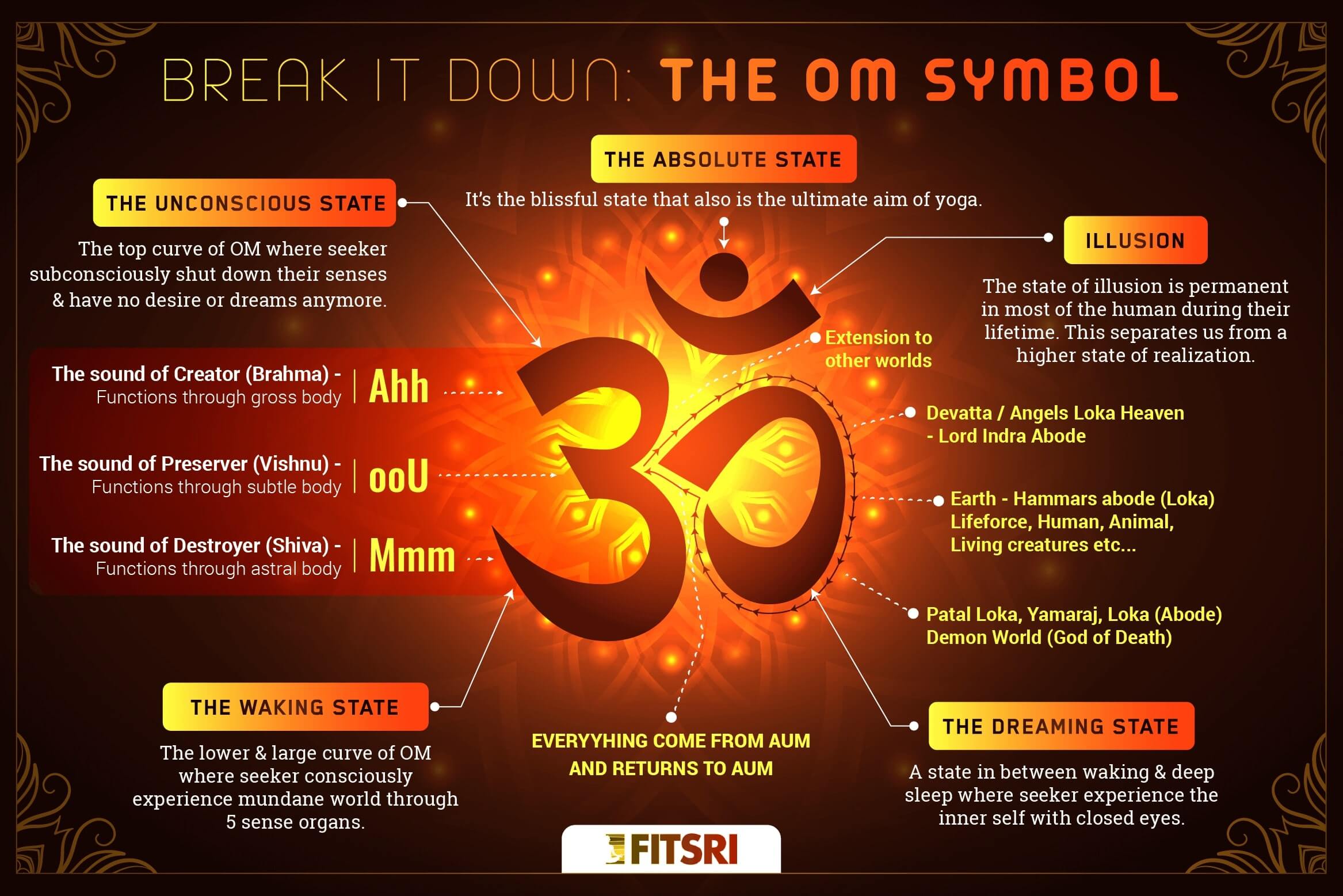
The image of OM holds the information of the universe inside its type. Many teachings say that the final word purpose of human life is hidden on this sacred image.
When examined carefully, OM has 4 key parts
- Three curved shapes
- One semicircle
- One dot
1. The three curves of OM
- Decrease Curve – Waking State (Jagrati): The decrease, bigger curve represents the waking state. Right here, consciousness flows outward by means of the senses. Its dimension exhibits that that is the commonest and dominant state for most individuals.
- Center Curve – Dreaming State (Swapna): The center curve represents the dreaming state, which lies between waking and deep sleep. On this state, consciousness strikes inward. With eyes closed, the practitioner enters an interior world to discover the self extra deeply.
- Higher Curve – Deep Sleep (Sushupti): The higher curve symbolises the deep sleep state, the place there aren’t any needs and no goals. This can be a quiet, undisturbed stage of consciousness.
2. The dot on the prime
The dot represents Turiya, the fourth state of consciousness. On this state, consciousness is neither turned inward nor outward. It’s a state of pure relaxation, peace, and bliss the final word purpose of non secular apply. Turiya additionally illuminates and helps the opposite three states.
3. The semicircle between the curves and the dot
The semicircle symbolises Maya, the barrier that stops us from realising the best state of bliss. It separates the person from Turiya. Nonetheless, the area between the semicircle and the dot exhibits that the best state stays untouched and unaffected by Maya.
On this means, the OM image superbly reveals the hidden function of life and the character of the universe.
Elemental sounds in om
OM is taken into account the unique vibration of the universe. It displays each Atman (the interior self) and Brahman (the supreme reality). When pronounced, OM divides into three sounds, and every carries a particular which means.
1. Ah
The sound “Ah” arises originally of the mantra. It represents Brahma, the creator. This sound pertains to the waking state and connects our gross consciousness to the decrease a part of the physique.
2. Ooh
The center sound “Ooh” attracts the practitioner deeper inward. It represents Vishnu, the preserver. This sound pertains to the dreaming state and connects our delicate consciousness to the center a part of the physique.
3. Mm
The ultimate sound “Mm” fades gently and leads the practitioner towards the supreme state. It represents Shiva, the destroyer. This sound is linked to the deep sleep state and connects our causal consciousness to the higher a part of the physique.
Why Do We Chant OM?
Most sounds and speech are produced by shifting the tongue. Nonetheless, once we chant OM, the three sounds Aa, Ooh, and Mm — are created clearly with out shifting the tongue. This makes OM probably the most primary and elementary sound in existence.
Our inside organs are extremely delicate to the vibrations generated by these three sounds. Since OM is taken into account the sound of creation, chanting it turns into a means of expressing gratitude to the supply of all life.
Fashionable science additionally means that every little thing in existence is a type of reverberation. Wherever there’s vibration, there’s sound — and wherever there’s sound, creation follows.
Simply as a tv makes use of three major color webs to create tens of millions of shades, the three sounds of OM mix to supply numerous energetic expressions.
- The sound “Aa” is common. It begins deep within the decrease physique, close to the navel, the place the 72,000 nadis (power channels) meet on the Manipura Chakra. Chanting “Aa” creates a vibration that spreads all through the complete system.
- The sound “Ooh” expands the vibration upward by means of the physique.
- The sound “Mm” creates a delicate, soothing vibration within the higher areas, particularly the pinnacle.
Every sound prompts a special dimension of the power system. Collectively, they stimulate and harmonise the entire physique. Sound not solely shapes our feelings — it will possibly rework the complete interior state.
For this reason chanting OM is taken into account a science: it helps life unfold inside you in its highest depth and deepest magnificence.
Advantages of Chanting OM
OM is a sound whose vibrations are believed to pervade the complete universe. Chanting OM in meditation provides numerous advantages on bodily, psychological, and emotional ranges. With common apply, this sacred syllable can carry highly effective modifications to 1’s life.
1. OM Cleanses the Surrounding
Chanting OM advantages not solely the practitioner but in addition the atmosphere. The sacred vibrations produced through the chant assist dispel detrimental energies and preserve a constructive ambiance. For this reason many conventional areas use OM chanting to purify and energise the environment.
2. Reduces stress and nervousness
In line with analysis, common OM chanting throughout meditation helps cut back stress and nervousness.
The vibrations activate particular centres and vagus nerve pathways, that are identified to calm the nervous system. OM chanting additionally influences the endocrine system, serving to regulate the chemical substances that contribute to emphasize and nervousness.
3. Strengthens the spinal twine
Chanting OM in a seated posture with a straight backbone has a constructive impact on the spinal twine.
The sound “Aa” originates close to the navel—near the spinal area—and its vibrations journey upward. These vibrations stimulate the nerves alongside the spinal twine, supporting higher operate and general energy.
4. Improves the digestive system
The digestive system is carefully linked to the vagus nerve, which begins within the medulla of the brainstem.
OM chanting stimulates this nerve, serving to regulate digestive exercise. Many practitioners report higher digestion and decreased digestive discomfort with constant chanting.
5. Maintains the thythmic exercise of the center
Chanting OM has a naturally calming impact on the center.
The sound “Ooh” rises from the navel in direction of the higher physique and spreads by means of the chest area. This vibration helps the center’s pure rhythm and promotes a balanced cardiac cycle.
6. Reduces fatigue by rising oxygen ranges within the blood
A 14-year-old Indian scholar found by means of her analysis that chanting OM will help cut back fatigue.
Her examine was impressed by seeing monks in Uttarakhand stroll lengthy distances whereas chanting OM constantly. She noticed that the rhythmic chanting improved oxygen ranges within the blood, which helped cut back tiredness and help bodily endurance.
OM Chanting FAQ’S
-
What number of instances ought to I chant the OM mantra?
You gained’t be harmed by over uttering or repeating this mantra. Nonetheless, 108 time OM chanting is taken into account as the best one. But when time is the problem, then one can chant 11 or 21 instances for the comfort.
-
What if I chant the OM mantra in being pregnant?
Garbha sanskar is an historical Indian ayurvedic apply, which is carried out to form the bodily, emotional and non secular facets of the unborn youngster. Chanting OM mantra generates the constructive vibrations that calm the mom and the child as properly. Chanting this sacred syllable helps in constructing the pure atmosphere for the child within the mom’s womb.
-
Daybreak or nightfall, what’s the greatest time to chant the OM mantra?
Usually one can apply the OM mantra at any time, however some fastened timing by the traditional sages is right in strategy. Brahmamahurta (4 a.m), transition interval or when the night time is popping into the dawn (daybreak and nightfall or dawn), when the day is popping into night time. These among the timing when you possibly can apply OM mantra chanting.
-
Can I chant OM mantra whereas touring or whereas sitting in an workplace?
Sure, you possibly can! There is no such thing as a downside in chanting the OM mantra whereas touring or whereas sitting within the workplace. Nonetheless, OM chanting improves your temper and makes you are feeling extra alive at given locations. This helps in a contented journey and a productive day on the workplace.
-
What ought to be the place of my physique whereas chanting OM mantra?
In line with the traditional yogis, a sitting place with an erect backbone is taken into account as the best place for the mantra chanting. This may be achieved by the Yogic poses, for instance, Padmasana (lotus pose).
-
My child desires to chant the OM mantra. What ought to I do?
You need to be glad that he/she desires to apply the sacred syllable, which goes to form his/her within the numerous facets of life. There is no such thing as a age restriction in working towards OM mantra chanting. Any age particular person can apply OM chanting.

